

Seller Checklist
The 14-Day Home Selling Checklist: What to Do Before Your Property Goes on Rightmove
A day-by-day plan for Manchester sellers — valuation, decluttering, repairs, photography and listing checks before your home appears on Rightmove.
Thinking about selling your home in South Manchester?
Before your property appears on Rightmove, there are several important steps worth taking.
From deciding on an asking price and completing minor repairs to preparing photographs and gathering documents, the work you do before launch can help your estate agent present your home accurately and professionally.
You do not necessarily need to spend thousands of pounds renovating your property.
Often, the most useful preparation involves improving presentation, addressing straightforward maintenance issues and making sure important information is ready.
At Delisa Miller (NW) Ltd, we understand that preparing a property for sale can feel like a substantial task.
That is why we have created this practical 14-day home selling checklist for Manchester homeowners.
It provides a suggested preparation schedule that you can adapt to your property, budget and circumstances.
Important: Fourteen days is a planning framework, not a guaranteed timeframe for marketing or selling a home. Some properties require additional documentation, repairs or preparation before they can be advertised.
Why preparing your property before listing matters
When buyers search for homes online, the property photographs, asking price, floor plan and description help them decide which listings to investigate.
An attractive property can still be difficult to market effectively if important information is missing or its presentation does not communicate the accommodation clearly.
Preparation can help you:
- Identify maintenance issues
- Present rooms effectively
- Organise property documents
- Arrange accurate photographs
- Review comparable sales
- Establish a realistic asking price
- Reduce avoidable delays before marketing
The goal is to help buyers understand your property and its features.
Day 1: Book your property valuation
Begin by understanding what your property could realistically achieve in the current market.
A professional estate agent valuation should consider recent comparable sales, the property's condition, size, location and current competition.
What to prepare
Have basic information ready about:
- Property type
- Bedroom count
- Tenure
- Extensions
- Improvements
- Parking
- Garden
- Known defects
Why start here?
A valuation can help you make informed decisions about your budget, selling timescale and whether any proposed improvements are worthwhile.
Book your free valuation at delisamiller.co.uk/selling/valuation.
Day 2: Review your asking-price strategy
An asking price should reflect relevant market evidence.
The highest suggested figure is not automatically the most accurate.
Questions to ask
- What have similar properties recently sold for?
- Which competing properties are currently available?
- How does my home compare?
- Who is the likely buyer?
- What marketing approach is recommended?
A credible estate agent should be able to explain the evidence behind their recommendation.
Seller tip
Avoid choosing an asking price solely because another property on your street is advertised at that figure.
An asking price is not proof of an achieved sale.
Day 3: Declutter your living spaces
Clutter can make rooms harder to interpret in photographs and during viewings.
Start with the main living room, dining area and kitchen.
Your tasks
- Remove unnecessary items
- Clear surfaces
- Organise visible storage
- Tidy shelves
- Create practical walking space
Why this matters
Buyers need to understand the room's layout and usable space.
The objective is not to remove every personal belonging.
It is to make the accommodation easier to assess.
Day 4: Organise bedrooms and storage
Bedrooms should be presented in a way that helps buyers understand their proportions and purpose.
Your tasks
- Make beds neatly
- Remove unnecessary furniture where practical
- Organise wardrobes
- Clear floor space
- Tidy bedside tables
- Check lighting
Flexible rooms
If a bedroom is currently used as a study, make sure its actual dimensions and current use are clear.
Avoid presenting rooms in a misleading way.
Day 5: Complete minor repairs
Small maintenance issues can distract buyers and raise questions about general upkeep.
Common tasks
- Tighten loose handles
- Repair dripping taps
- Replace faulty bulbs
- Fix damaged cupboard fittings
- Touch up minor scuffs
- Repair small defects where appropriate
When to use professionals
Electrical, gas, structural and other specialist work should be handled by appropriately qualified contractors.
Do not attempt repairs that require expertise or legal certification.
Should you renovate?
Major renovation is not automatically necessary before selling.
Discuss substantial expenditure with your estate agent before proceeding.
Day 6: Deep-clean the kitchen and bathrooms
Kitchens and bathrooms are important areas for property presentation.
Cleanliness can help buyers assess fixtures and finishes.
Kitchen checklist
- Clean worktops
- Wipe cupboard fronts
- Clean the sink
- Remove washing-up
- Clean visible appliances
- Tidy dining surfaces
Bathroom checklist
- Clean mirrors
- Remove unnecessary toiletries
- Clean taps
- Check seals
- Tidy towels
- Improve ventilation where appropriate
A clean room can photograph more clearly without requiring expensive changes.
Day 7: Prepare the garden and entrance
The exterior can create an important first impression.
Front entrance
Consider:
- Sweeping paths
- Removing unnecessary items
- Tidying planting
- Cleaning the front door
- Checking gates
- Presenting parking areas clearly
Garden
If your property has outdoor space:
- Cut grass
- Remove weeds
- Clean patios
- Tidy furniture
- Check boundaries
What if you have an apartment?
Focus on any balcony or terrace and ensure that photographs of communal areas are accurate and appropriately authorised.
Day 8: Check lighting and room presentation
Natural and artificial lighting can influence how clearly a room appears in photographs.
Your tasks
- Clean accessible windows
- Open curtains and blinds
- Replace faulty bulbs
- Check ceiling and wall lights
- Arrange furniture logically
- Remove unnecessary visual distractions
Avoid misleading staging
Presentation should not conceal material defects or create a false impression of room size.
The goal is to show the real property at its best.
Day 9: Gather important property documents
Organising documents early may help avoid questions later in the selling process.
Documents to locate
Depending on your property, these may include:
- Title information
- Planning permissions
- Building regulations approvals
- Relevant guarantees
- FENSA or equivalent window documentation where applicable
- Boiler and heating records
- Electrical documentation
- Leasehold information
- Service charge statements
- Ground rent information where applicable
Why early preparation matters
Missing paperwork can create delays or require additional enquiries.
Not every property needs every document listed above.
Your estate agent and conveyancer can explain what is relevant.
Day 10: Check the EPC and floor-plan arrangements
An Energy Performance Certificate provides information about a property's energy efficiency.
For many residential sales, a valid EPC must be available in accordance with the applicable regulations.
What should you do?
Check whether your property has a valid EPC.
If not, discuss arranging one with your estate agent.
Floor plans
A clear, accurate floor plan helps buyers understand the layout and accommodation.
Make sure room labels and measurements are checked before publication.
Day 11: Prepare for professional photography
Property photographs are an important part of online marketing.
What should be photographed?
Depending on the home:
- Front exterior
- Living room
- Kitchen
- Dining area
- Main bedroom
- Other bedrooms
- Bathroom
- Garden
- Parking
- Distinctive features
Final preparation
Before the photographer arrives:
- Declutter surfaces
- Make beds
- Clean mirrors
- Open curtains
- Tidy outdoor space
- Check lighting
Why accuracy matters
Photography should not distort room proportions or conceal significant defects.
Day 12: Arrange photography and review the presentation
Work with your estate agent to ensure the photographs communicate the property's key features.
Questions to consider
- Is every important room represented?
- Are the photographs clear?
- Is the garden shown?
- Are the strongest features visible?
- Does the sequence make sense?
- Are the images accurate?
Property descriptions
Begin checking the details that will appear in your listing.
These should accurately describe the accommodation and relevant features.
Day 13: Review your listing before publication
Before your home goes live, review the proposed advert carefully.
Check the following
- Asking price
- Address and location
- Property type
- Bedroom count
- Tenure information
- Photographs
- Floor plan
- Property description
- EPC information
- Material property information
- Viewing arrangements
Why material information matters
Estate agents must comply with applicable consumer protection requirements.
Important information that could affect a buyer's decision should not be omitted or misrepresented.
Seller tip
If anything is unclear or inaccurate, raise it before the listing is published.
Day 14: Approve your marketing and prepare for launch
Once the necessary checks and arrangements are complete, your property may be ready to be advertised.
Before going live
Confirm:
- The agreed asking price
- Marketing materials
- Property information
- Photography
- Viewing arrangements
- Contact details
- Your estate agent's communication process
What happens next?
After launch, your agent can begin managing enquiries and arranging viewings.
However, listing on Rightmove does not guarantee enquiries or a sale within a particular timeframe.
Buyer response will depend on factors including asking price, location, condition and market circumstances.
What happens after your property goes live?
Preparing the advert is only the beginning of the selling process.
1. Buyer enquiries
Your estate agent handles interest from prospective buyers.
2. Viewings
Interested buyers may arrange to inspect the property.
3. Feedback
Viewing feedback can help identify how buyers perceive the home.
4. Offers
Potential buyers may submit offers.
5. Negotiation
Your estate agent can discuss the terms of any offer with you.
6. Conveyancing
Once an offer is accepted, the legal process begins.
An accepted offer is not the same as a completed sale.
How long does it take to prepare a house for sale?
There is no fixed timeframe.
Some homeowners can complete their preparation quickly.
Others may need additional time for repairs, certificates, leasehold information or other matters.
Factors affecting preparation time
- Property condition
- Documentation
- Availability of contractors
- Photography appointments
- EPC requirements
- Legal issues
- Personal circumstances
The 14-day schedule is intended as an organisational tool rather than a guarantee.
Should you spend money improving your home before selling?
Not every improvement produces an equivalent increase in sale price.
Lower-cost preparation
Tasks such as cleaning, decluttering and minor repairs may improve presentation without substantial expenditure.
Higher-cost work
Major renovations, extensions and significant landscaping can be expensive.
Before proceeding, consider the likely benefits and obtain appropriate advice.
Why a valuation helps
An estate agent can explain how your property's current condition compares with relevant local sales.
That information can help you decide which improvements are worthwhile.
Why South Manchester property presentation should be tailored
Different property types benefit from different marketing priorities.
Didsbury and Chorlton
Period houses may have architectural details, gardens and distinctive interiors worth highlighting.
Withington and Fallowfield
Traditional terraces and investment properties may require different marketing approaches depending on their use and likely buyer audience.
Hulme
Apartments may benefit from clear floor plans, accurate leasehold information and photographs of relevant facilities.
Stretford and Wythenshawe
Family homes may benefit from highlighting practical living space, gardens and parking where available.
These are examples, not fixed rules for every property.
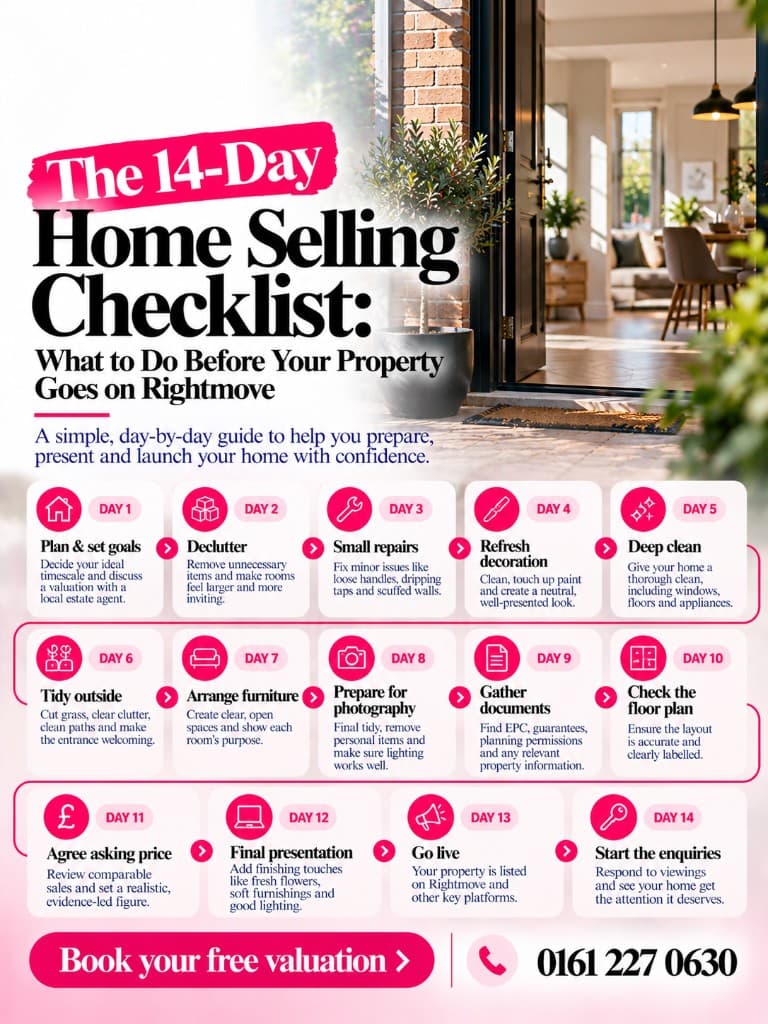
The complete 14-day checklist
Use this as your quick reference before listing.
- Day 1: Book a property valuation
- Day 2: Review the asking-price strategy
- Day 3: Declutter living spaces
- Day 4: Organise bedrooms and storage
- Day 5: Complete minor repairs
- Day 6: Deep-clean kitchen and bathrooms
- Day 7: Tidy garden and entrance
- Day 8: Check lighting and presentation
- Day 9: Gather property documents
- Day 10: Check EPC and floor-plan arrangements
- Day 11: Prepare for photography
- Day 12: Arrange photographs and review presentation
- Day 13: Check the listing details
- Day 14: Approve marketing and prepare for launch
The key to a well-prepared property launch
Selling a home involves more than uploading photographs and choosing an asking price.
The preparation stage is an opportunity to organise information, address issues and present your property clearly.
A realistic valuation, accurate marketing materials and a practical preparation plan can help you approach the process with greater confidence.
You do not need to make your property perfect. You need to prepare it properly for the market.
Thinking of selling your home in South Manchester?
At Delisa Miller (NW) Ltd, we help homeowners across Manchester explore their selling options and prepare their properties for marketing.
Whether you are selling a Victorian terrace, modern apartment or family house, a professional valuation is a useful first step.
Book your free, no-obligation property valuation at delisamiller.co.uk/selling/valuation or call 0161 227 0630.
Delisa Miller (NW) Ltd — 44 Hulme High Street, Manchester, M15 5JP.
This article provides general property-selling guidance. The 14-day schedule is illustrative and does not guarantee that a property can be marketed within that period or sold within any particular timeframe. Legal, EPC and property-information requirements should be checked against the rules applicable to the individual property.
Related reading
Got a Property Question?
Our team is here to help. Whether you're buying, selling or letting — get in touch today.