

Investor Comparison
Fallowfield vs Withington vs Rusholme: Where Does Rental Property Fit Best in 2026?
Three neighbouring South Manchester markets compared for landlords — property types, yields, HMO rules, management and exit strategy in 2026.
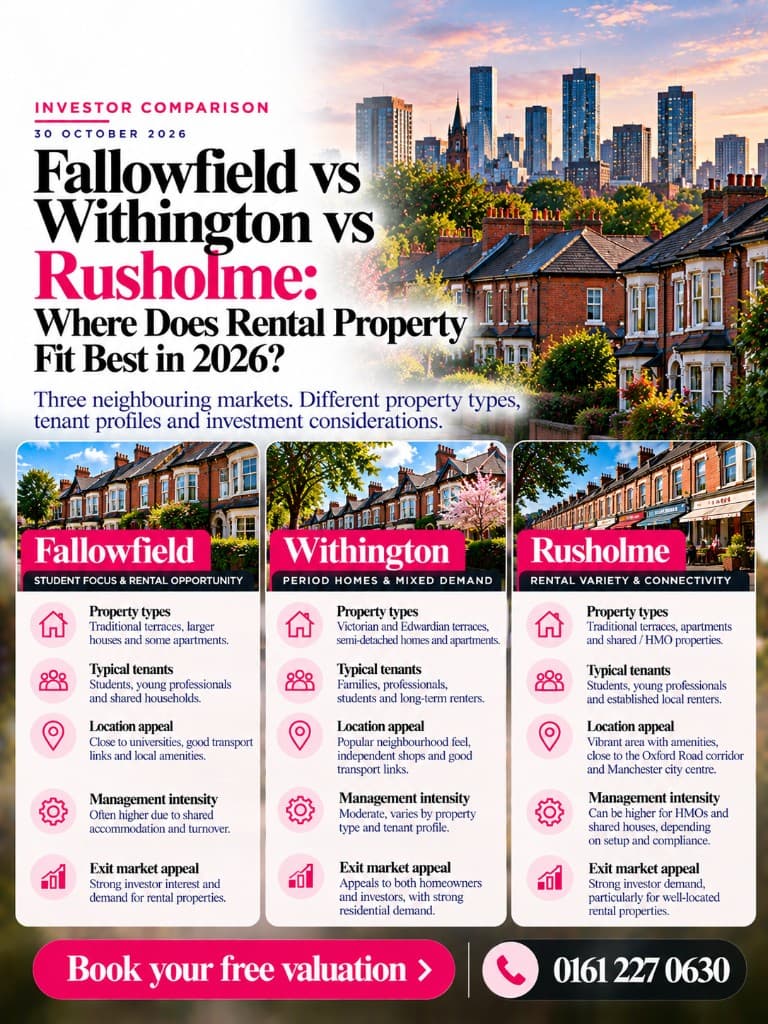
If you are considering buying, retaining or selling rental property in South Manchester, Fallowfield, Withington and Rusholme are three neighbouring areas worth comparing.
Each contains traditional residential housing and accommodation used for private renting. However, their property characteristics, local surroundings and management considerations are not identical.
Fallowfield is closely associated with Manchester's student accommodation market. Withington offers a mixture of period housing, flats and family homes. Rusholme combines established residential streets with commercial activity and access to the wider Oxford Road and Wilmslow Road corridor.
But which area is most suitable for property investment in 2026?
The answer depends on the individual property, purchase price, rental income, running costs, legal requirements and your long-term objectives.
A property offering an attractive headline yield may also involve significant management, maintenance or compliance expenditure.
Equally, a home with a lower gross yield may appeal to a wider range of buyers when you eventually decide to sell.
In this guide, Delisa Miller (NW) Ltd compares Fallowfield, Withington and Rusholme from a landlord and investor perspective, focusing on property types, tenant considerations, management responsibilities and resale flexibility.
1. Why compare these three South Manchester areas?
Fallowfield, Withington and Rusholme are geographically close, but investors should not treat them as one uniform rental market.
The available housing stock, lawful uses and property-specific costs can differ considerably.
A terraced house operating as shared accommodation may have different financial and management characteristics from a single-household rental property.
Similarly, an apartment may involve leasehold costs that do not apply to a freehold house.
What should investors compare?
Before choosing a location, consider:
- Purchase price
- Property type
- Internal floor area
- Current condition
- Rental income
- Operating costs
- Lawful occupancy
- Licensing
- Tenancy arrangements
- Maintenance requirements
- Potential resale audience
Location matters, but it is only one part of the investment decision.
2. Fallowfield: Student accommodation and traditional terraces
Fallowfield is an established South Manchester residential area associated with student accommodation and university-related housing.
Its property stock includes traditional terraced houses, semi-detached properties, flats and shared rental accommodation.
What types of rental property might investors encounter?
Depending on availability:
- Traditional terraces
- Student rental houses
- HMOs
- Single-household rental homes
- Flats and apartments
What should investors consider?
Some shared rental properties may involve additional licensing, safety and management requirements.
Investors should establish whether the property's current use is lawful and understand any relevant conditions.
Tenant considerations
Student accommodation may involve different letting cycles and property requirements from other residential rentals.
However, not every property in Fallowfield is a student rental.
Demand must be assessed at the individual property level.
3. Withington: Mixed residential housing and rental options
Withington is an established neighbourhood with period terraces, semi-detached homes, flats and other residential accommodation.
Its range of property types may be relevant to investors considering different letting strategies.
Property characteristics
Investors may encounter:
- Victorian terraces
- Edwardian houses
- Semi-detached homes
- Converted flats
- Shared accommodation
- Conventional residential rentals
Why property type matters
A traditional house may appeal to owner-occupiers as well as investors, depending on its condition, legal status and tenancy arrangements.
However, this does not guarantee a wider buyer audience or a higher resale price.
Management considerations
Older buildings may require expenditure on roofs, windows, heating, ventilation and other maintenance.
Converted flats can also involve leasehold obligations.
4. Rusholme: Traditional housing and shared-rental considerations
Rusholme contains traditional terraced housing, flats and other residential accommodation.
Its location near the Wilmslow Road corridor and surrounding educational and employment areas may be relevant to prospective tenants.
Property types
These may include:
- Terraced houses
- Converted properties
- Flats
- Shared accommodation
- HMOs
What should investors investigate?
Relevant matters include:
- Property condition
- Rental arrangements
- Lawful occupancy
- Licensing
- Maintenance
- Management workload
- Comparable rental properties
Avoid assumptions
A property's location does not guarantee a particular rent, occupancy rate or investment return.
Current local evidence is needed.
5. Fallowfield vs Withington vs Rusholme: At a glance
This comparison describes possible property characteristics rather than verified rental-demand rankings.
Fallowfield
- Housing characteristics: terraces, houses, flats and shared rentals
- Rental considerations: student accommodation and other rental types
- Management considerations: potential shared-housing workload
- Property costs: condition, compliance and operating costs
- Resale considerations: investor and possible owner-occupier interest, depending on property
Withington
- Housing characteristics: period terraces, semis, flats and shared rentals
- Rental considerations: mixed residential property types
- Management considerations: varies by property and tenancy
- Property costs: older-building and leasehold considerations where relevant
- Resale considerations: potentially different buyer audiences by property type
Rusholme
- Housing characteristics: terraces, flats and shared accommodation
- Rental considerations: mixed rentals and shared accommodation
- Management considerations: potential shared-housing workload
- Property costs: condition, compliance and operating costs
- Resale considerations: investor and possible owner-occupier interest, depending on property
6. What is gross rental yield?
Gross rental yield compares annual rent with property value or purchase price.
The standard calculation is gross rental yield = annual rental income ÷ property value × 100.
Illustrative example
Suppose an investment property has a value of £250,000 and monthly rent of £1,250.
Annual rent would be £15,000.
Its gross yield would be £15,000 ÷ £250,000 × 100 = 6%.
These figures are hypothetical and are not current rental-market averages for any of the three areas.
Why gross yield is limited
Gross yield does not deduct running costs.
It should not be treated as the investor's actual return.
7. Why the highest yield is not always the best investment
Consider two hypothetical properties.
Property A
Offers a relatively high gross yield but requires significant repairs and more intensive management.
Property B
Offers a lower gross yield but has different maintenance requirements and tenancy arrangements.
Which is more suitable?
The answer depends on the full financial position and the investor's objectives.
Costs that may affect returns
- Repairs
- Insurance
- Management
- Licensing
- Compliance
- Vacancy
- Mortgage costs
- Service charges
- Tax
Investors should assess net performance and cash flow rather than gross rent alone.
8. Understanding net rental yield
Net yield attempts to account for relevant operating expenses.
However, different calculations may include different costs.
Why consistency matters
When comparing properties, use the same method for each.
Identify which expenses are included and which are excluded.
Mortgage finance and tax may require separate assessment.
Example of operating expenses
An investor might consider:
- Letting fees
- Management fees
- Maintenance
- Insurance
- Compliance
- Expected vacancy
The precise figures depend on the property.
9. Tenant demand: Why property type matters
Rental demand is not identical across every property in a neighbourhood.
Student accommodation
Some properties may be marketed to students seeking shared accommodation.
Professional renters
Some prospective tenants may prioritise access to employment, transport and local amenities.
Households seeking conventional rentals
Other applicants may focus on room layout, outdoor space and practical living arrangements.
Why investors should avoid stereotypes
Tenant preferences vary.
Marketing and applicant selection must comply with applicable anti-discrimination requirements.
The relevant question is whether a property is suitable and competitively positioned for its intended rental market.
10. Understanding HMOs and shared housing
A house in multiple occupation generally involves occupants forming more than one household and sharing certain facilities, subject to statutory definitions and exceptions.
Some shared student properties are HMOs.
Licensing
In England, mandatory HMO licensing generally applies to qualifying properties occupied by five or more people forming two or more households.
Additional licensing schemes may also apply.
Landlords should check current Manchester City Council requirements.
Why HMO status matters
Relevant considerations may include:
- Lawful use
- Licensing
- Occupancy limits
- Fire precautions
- Room sizes
- Shared facilities
- Management obligations
Investors should not assume that an advertised bedroom count establishes permitted occupancy.
11. Does shared accommodation involve more management?
Some shared properties may require additional administration.
However, the actual workload depends on the tenancy structure, number of occupants, property condition and management arrangements.
Potential responsibilities
- Coordinating repairs
- Managing shared facilities
- Communicating with occupants
- Arranging lawful inspections
- Maintaining safety documentation
- Handling tenancy administration
- Managing relevant licence conditions
Why this affects investment decisions
Management involves time and potentially additional costs.
These should be considered alongside rental income.
12. Maintenance in traditional Manchester properties
Fallowfield, Withington and Rusholme all contain older residential buildings.
Period properties may have attractive architectural features but can also require maintenance.
Common considerations
- Roofing
- Gutters
- Windows
- Heating
- Ventilation
- Damp
- External brickwork
- Drainage
Before buying
Commission appropriate surveys and investigations.
A property that appears attractive in photographs may still have defects requiring expenditure.
13. Leasehold apartments versus freehold houses
Some investors may consider apartments as an alternative to houses.
Leasehold considerations
These may include:
- Service charges
- Ground rent where applicable
- Lease length
- Subletting restrictions
- Building management
- Major works
- Relevant building safety matters
Freehold houses
Freehold ownership may involve different responsibilities and fewer shared-building arrangements, but ongoing maintenance remains important.
Why compare total costs?
Purchase price alone does not establish which property is more economical to own.
14. Transport and location considerations
Transport links can influence the suitability of a rental property for prospective tenants.
Fallowfield
Consider the property's access to local amenities and relevant bus routes.
Withington
Review transport connections, local services and the property's exact position.
Rusholme
Consider access to Wilmslow Road, nearby facilities and the wider transport network.
Important distinction
These areas are associated with the wider Oxford Road and Wilmslow Road corridor, particularly bus connections.
They should not be described as having a Metrolink route running directly along Oxford Road.
15. How to assess a rental property's asking price
An asking price should be assessed alongside relevant comparable transactions.
Useful comparisons
Consider:
- Property type
- Floor area
- Condition
- Tenure
- Legal use
- Rental income
- Operating costs
- Recent comparable sales
Why investor valuations can differ
Some investment properties may require analysis of rental performance and lawful occupancy in addition to conventional residential comparable evidence.
However, rental income does not automatically determine market value.
16. What is an exit strategy?
An exit strategy describes how an investor might eventually dispose of an asset.
For property, this could involve selling to another investor or to an owner-occupier where appropriate.
Questions to consider
- Who might buy the property?
- Would existing tenancy arrangements affect the sale?
- Is the property's use lawful?
- Would alterations be required for a different use?
- What maintenance might be needed before selling?
- What transaction costs and taxes could apply?
Why resale flexibility matters
A property that appeals to a particular investor audience may have different resale considerations from a conventional family home.
Neither is automatically superior.
17. Selling a tenanted investment property
A property may be sold while tenants are living in it.
However, the tenancy arrangements can affect marketing and the transaction.
Selling with tenants
Some investors may consider purchasing a property subject to existing tenancy arrangements.
Selling with vacant possession
Other buyers may require the property to be vacant.
However, selling does not automatically terminate a tenancy.
Landlords must follow the applicable legal process.
Seek advice
A qualified solicitor or conveyancer can explain the legal position.
18. What does full property management involve?
Some investors prefer to appoint an agent to undertake agreed letting and management tasks.
Services may include:
- Marketing
- Applicant enquiries
- Referencing
- Tenancy administration
- Rent collection
- Maintenance coordination
- Tenant communication
- Inspections
- Landlord statements
The precise service depends on the agreement.
Does management guarantee better returns?
No.
Professional management may reduce the owner's day-to-day administrative workload, but it does not guarantee rental income, occupancy or investment performance.
19. How tax can affect investment returns
Rental income and property disposals may have tax implications.
Relevant considerations can include:
- Income Tax
- Capital Gains Tax
- Stamp Duty Land Tax
- Ownership structure
- Allowable expenses
- Mortgage interest treatment
Tax rules depend on individual circumstances and the law in force.
Investors should obtain advice from a qualified tax professional.
20. A practical investment comparison checklist
Before buying or retaining rental property in Fallowfield, Withington or Rusholme:
- Confirm the property's legal status
- Review purchase price and acquisition costs
- Assess current rental income
- Check comparable rents
- Calculate operating expenses
- Review maintenance requirements
- Confirm licensing obligations
- Check lawful occupancy
- Review tenancy arrangements
- Consider management workload
- Assess mortgage costs
- Consider tax implications
- Review resale options
- Obtain appropriate professional advice
21. Which area is best for rental property investment?
There is no reliable single winner between Fallowfield, Withington and Rusholme.
Each neighbourhood contains different property types and rental arrangements.
Fallowfield may be relevant to investors researching student accommodation.
Withington offers a mixture of traditional residential property types.
Rusholme includes established housing and shared-rental accommodation.
However, the suitability of any investment depends on the individual property, not simply the neighbourhood name.
The key questions
What will the property cost to acquire and maintain?
What rental income is realistically achievable?
What legal obligations apply?
How much management is involved?
Who might buy the property when you decide to sell?
A well-informed investment decision considers the whole property — not just the headline yield.
Own an investment property in South Manchester?
At Delisa Miller (NW) Ltd, we help property owners across Manchester explore their selling and letting options.
Whether you own a student rental in Fallowfield, a period property in Withington or a shared house in Rusholme, understanding your property's current market position can help you plan your next move.
If you are considering selling, releasing equity or reviewing your property portfolio, contact our team.
Book your free, no-obligation property valuation at delisamiller.co.uk/selling/valuation or call 0161 227 0630.
For lettings support, see delisamiller.co.uk/letting/rental-valuation.
Delisa Miller (NW) Ltd — 44 Hulme High Street, Manchester, M15 5JP.
This article provides general property information and is not financial, investment, tax or legal advice. It does not present verified October 2026 rental-yield or demand statistics. Individual property performance and legal obligations should be assessed using current, property-specific evidence and appropriate professional advice.
Related reading
Need lettings or property management?
Free rental valuation, tenant find and full management across Hulme and South Manchester.