

Seller Checklist
Hulme Leasehold Seller Checklist: What to Prepare Before You List Your Apartment
Lease length, service charges, management packs and building safety — the documents Hulme apartment sellers should gather before marketing in 2026.
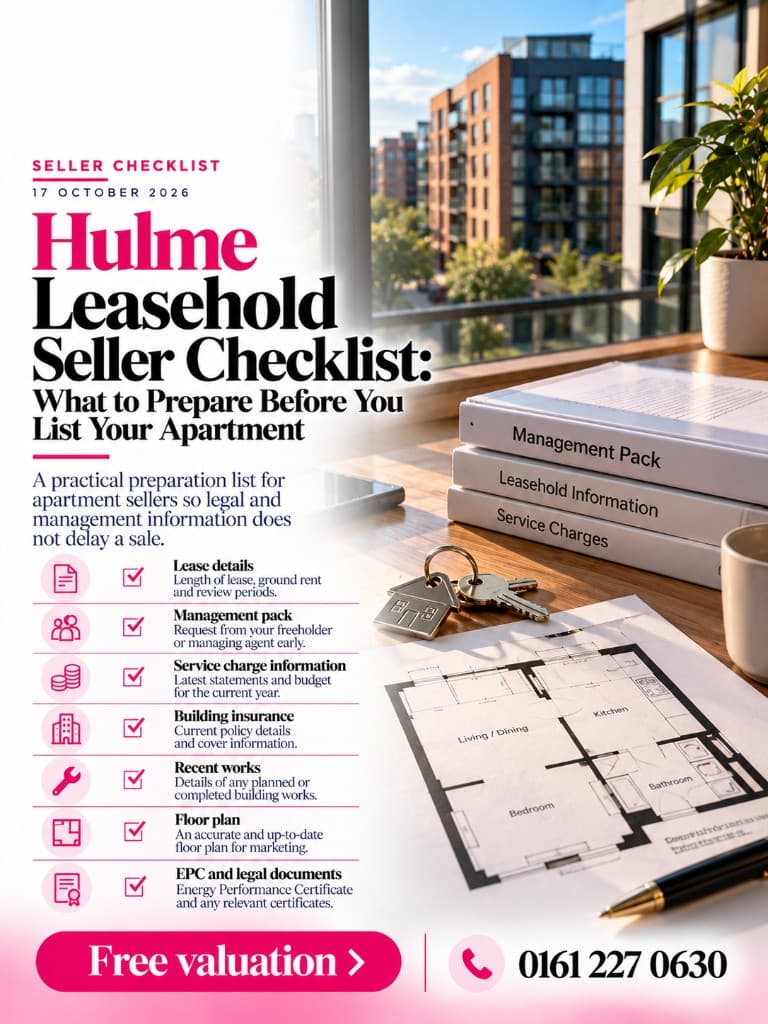
Selling an apartment in Hulme, Manchester, involves many of the same steps as selling a freehold house. However, leasehold properties often require additional information about the building, its management and the financial responsibilities attached to ownership.
If this information is missing or takes time to obtain, it can delay the legal process after an offer has been accepted.
The good news is that apartment owners can begin preparing much of the relevant information before their property is advertised.
In this guide, Delisa Miller (NW) Ltd explains what leasehold sellers in Hulme should check, which documents may be needed and how early preparation can help make the selling process more straightforward.
1. Understand your lease before selling
The lease is one of the most important documents associated with a leasehold property.
It sets out the rights and obligations attached to ownership, including the length of the lease and arrangements for the building.
Check the remaining lease term
Find out how many years remain on your lease.
A shorter lease can affect buyer interest, mortgage availability and potentially the property's value.
If your lease is approaching or has fallen below 80 years, obtaining specialist advice early can be particularly important because lease extension costs and statutory rules may be relevant.
Leasehold legislation is subject to reform, so do not assume that announced changes are already in force.
A solicitor specialising in leasehold conveyancing can explain the current rules and options.
Locate your lease documents
If you cannot find a copy, ask your conveyancer about obtaining the relevant title and lease information from HM Land Registry.
2. Gather service charge information
Many leasehold apartment owners contribute towards the upkeep and management of shared areas through service charges.
These may cover services such as:
- Cleaning and maintenance of communal areas
- Lift servicing
- Shared lighting
- Building repairs
- Grounds maintenance
- Managing agent fees
- Buildings insurance, where included
- Reserve or sinking fund contributions
What should you prepare?
Gather recent service charge statements, payment demands, budgets and any information about outstanding balances.
Your solicitor may need additional records from the managing agent or freeholder.
Why do buyers care?
Service charges form part of the ongoing cost of owning the apartment.
Buyers may want to understand what the charges cover, whether they fluctuate and whether significant expenditure is anticipated.
Accurate disclosure helps buyers assess affordability.
3. Confirm your ground rent arrangements
Some leasehold properties have ground rent obligations.
Check the lease to establish whether ground rent is payable, how much is due and whether the amount changes over time.
The rules governing ground rent depend partly on when and how a lease was granted.
For example, many qualifying new residential long leases granted since the relevant provisions of the Leasehold Reform (Ground Rent) Act 2022 came into force are subject to restrictions on ground rent.
However, existing leases may operate differently.
What should sellers provide?
Have any ground rent statements and payment records available.
Your conveyancer can confirm which information needs to be supplied to the buyer's solicitor.
4. Ask about the leasehold management pack
A management information pack is commonly required during the sale of a leasehold apartment.
It helps the buyer's solicitor understand the building's management arrangements and the financial obligations associated with the property.
What is an LPE1 form?
The Leasehold Property Enquiries form, commonly called LPE1, is a standardised form used to obtain information from a landlord, managing agent or management company.
It may address matters such as:
- Service charges
- Ground rent
- Building insurance
- Planned major works
- Disputes
- Management arrangements
- Other leasehold obligations
Additional documents may accompany the completed enquiries.
When should you request the pack?
Speak to your conveyancer early about when the pack should be ordered.
Some managing agents charge a fee and require time to prepare the information.
Starting the process early can help identify potential delays, although it does not guarantee that the legal process will be completed within a particular timeframe.
5. Check buildings insurance arrangements
In many apartment buildings, buildings insurance is arranged through the freeholder or management company.
However, arrangements vary.
Buyers and mortgage lenders may require information about the policy and the building's insurance cover.
Documents that may be relevant
Your solicitor may request the current insurance schedule, policy details or confirmation of the building's insurance arrangements.
If you are unsure who arranges the insurance, contact your managing agent or review your service charge documentation.
6. Identify planned major works
Major works can be an important consideration when selling a leasehold flat.
Examples may include:
- Roof repairs
- External building maintenance
- Lift replacement
- Communal-area refurbishment
- Structural repairs
- Fire-safety improvements
Depending on the lease and circumstances, leaseholders may be required to contribute towards certain works.
Why does this matter?
Buyers may need to understand whether significant costs are anticipated.
Information about consultations, planned projects and reserve funds can therefore be relevant.
If you have received notices concerning major works, provide them to your conveyancer.
Avoid making assumptions about future costs until the position has been confirmed.
7. Check whether building safety documentation is relevant
Building safety is an important issue for some leasehold apartment sales.
The documentation required can depend on the building's characteristics, including its height, construction and applicable legal requirements.
Fire safety and external walls
Some transactions may involve questions about external wall systems, fire-risk assessments or remediation work.
An EWS1 form is not automatically required for every apartment building.
Whether a lender or valuer requests one depends on the relevant circumstances and lending requirements.
Building Safety Act considerations
Certain leasehold properties may require additional information relating to the Building Safety Act 2022 and associated protections.
Where applicable, documents such as leaseholder certificates or landlord certificates may be relevant.
The requirements can be complex.
If your apartment is in a building affected by building-safety issues, obtain advice from a qualified conveyancer before marketing or agreeing to sell.
8. Locate permissions for alterations
Have you made changes to your apartment since purchasing it?
Examples might include:
- Removing internal walls
- Changing windows
- Altering plumbing
- Reconfiguring rooms
- Installing certain fixtures
- Carrying out structural work
Some alterations may require permission under the lease, building regulations approval or other consent.
What should you do?
Gather any relevant certificates, permissions and correspondence.
If you believe work was completed without a necessary approval, seek professional advice before taking action.
Trying to resolve an issue without advice may complicate the position.
9. Prepare your Energy Performance Certificate
An Energy Performance Certificate, or EPC, provides information about a property's energy performance.
In most cases, a valid EPC is required when marketing a residential property for sale, subject to applicable exemptions.
Check whether your EPC is valid
EPCs generally remain valid for ten years.
You can check the official register to see whether your apartment has a current certificate.
If a valid EPC is not available and no exemption applies, arrange for an appropriate assessment.
Why is the EPC useful?
It provides buyers with information about energy performance and recommendations for potential improvements.
It should be available as required during the marketing process.
10. Arrange an accurate floor plan
A clear floor plan can help prospective buyers understand the layout and size of your apartment.
It may show:
- Bedroom locations
- Living and dining areas
- Kitchen arrangement
- Bathrooms
- Storage
- Balconies or terraces, where applicable
Floor plans should accurately reflect the property.
If previous alterations have changed the layout, make sure the marketing information is updated.
11. Gather property ownership and identification documents
Your conveyancer will usually need to verify your identity and establish your authority to sell the property.
Depending on the circumstances, you may be asked for:
- Identification documents
- Proof of address
- Mortgage account details
- Ownership information
- Relevant legal documents
If the property is jointly owned, all relevant owners may need to participate in the transaction.
Your conveyancer will explain the specific requirements.
12. Be ready to complete property information forms
Sellers are commonly asked to complete forms providing information about the property.
These may include the TA6 Property Information Form and the TA7 Leasehold Information Form, depending on the transaction and conveyancing arrangements.
The forms may ask about matters such as disputes, alterations, utilities, boundaries and leasehold obligations.
Why accuracy matters
Provide complete and accurate answers based on the information available to you.
If you do not know an answer, explain that rather than guessing.
Your solicitor can advise you on how to deal with uncertain or complicated matters.
13. Understand the costs of selling a leasehold apartment
In addition to estate agency and conveyancing fees, leasehold sales may involve other charges.
Depending on the property and lease, these can include:
- Management pack fees
- Landlord or managing agent administration charges
- Fees for certain certificates or consents
- Lease-related legal work
- Other transaction-specific costs
Not every fee applies to every sale.
Ask your conveyancer to help identify likely costs early so you can plan accordingly.
14. How long does selling a leasehold flat take?
There is no guaranteed timescale.
A leasehold sale can involve additional enquiries and third parties, including freeholders, managing agents and mortgage lenders.
Potential sources of delay include:
- Missing lease documents
- Slow management pack responses
- Unresolved service charge questions
- Short lease issues
- Building safety enquiries
- Outstanding permissions
- Buyer mortgage requirements
Preparing early may reduce avoidable delays, but some factors remain outside the seller's control.
15. Your Hulme leasehold seller checklist
Use this practical checklist before listing your apartment:
- Check how many years remain on your lease
- Locate your lease and title information
- Gather service charge statements and budgets
- Confirm ground rent arrangements
- Speak to your conveyancer about the LPE1 management pack
- Check buildings insurance information
- Gather notices about major works
- Identify any relevant building safety documentation
- Locate permissions for alterations
- Check your EPC is valid
- Arrange an accurate floor plan
- Prepare identification and ownership documents
- Discuss likely leasehold sale fees
- Arrange a professional property valuation
16. Why local knowledge matters when selling in Hulme
Hulme contains a range of apartments and residential developments, each with potentially different lease and management arrangements.
Two apartments with similar layouts may have different ongoing costs, lease terms or building characteristics.
These differences can affect buyer decisions and may influence valuation.
A professional valuation should therefore consider more than bedroom count and floor area.
It should also account for the property's condition, location, tenure and relevant comparable sales.
17. Preparing your apartment for marketing
Once the legal preparation is underway, attention can turn to presenting your apartment to buyers.
Consider the following steps.
Declutter living areas
Help buyers understand the available space.
Highlight natural light
Open curtains and make rooms feel bright and welcoming.
Prepare outdoor areas
If the apartment has a balcony or terrace, present it clearly and safely.
Address minor maintenance
Repair small defects where appropriate and ensure the property is presented accurately.
Arrange professional photography
Good-quality images and a clear floor plan can help prospective buyers assess the property before viewing.
Set an evidence-led asking price
Use recent comparable sales and relevant property information to establish a realistic marketing strategy.
Thinking of selling your leasehold apartment in Hulme?
Preparing your documents early can make the selling process more manageable and help identify issues before they become obstacles.
At Delisa Miller (NW) Ltd, we help homeowners across Hulme and South Manchester understand their property's position in the local market.
If you are considering selling your apartment, our team can help you explore your valuation and marketing options.
Book your free, no-obligation property valuation at delisamiller.co.uk/selling/valuation or call 0161 227 0630.
Delisa Miller (NW) Ltd — 44 Hulme High Street, Manchester, M15 5JP.
This article provides general information about selling leasehold property in England. It is not legal advice. Lease terms, building safety requirements and transaction documents vary. Sellers should consult a qualified conveyancer for advice specific to their property.
Related reading
Got a Property Question?
Our team is here to help. Whether you're buying, selling or letting — get in touch today.