

Valuation Guide
How Much Should You Ask for Your Home? Why the Highest Valuation Isn't Always the Best
Evidence-led pricing, the risks of inflated valuations and the cost of sitting on the market — what South Manchester sellers should know before choosing an asking price.
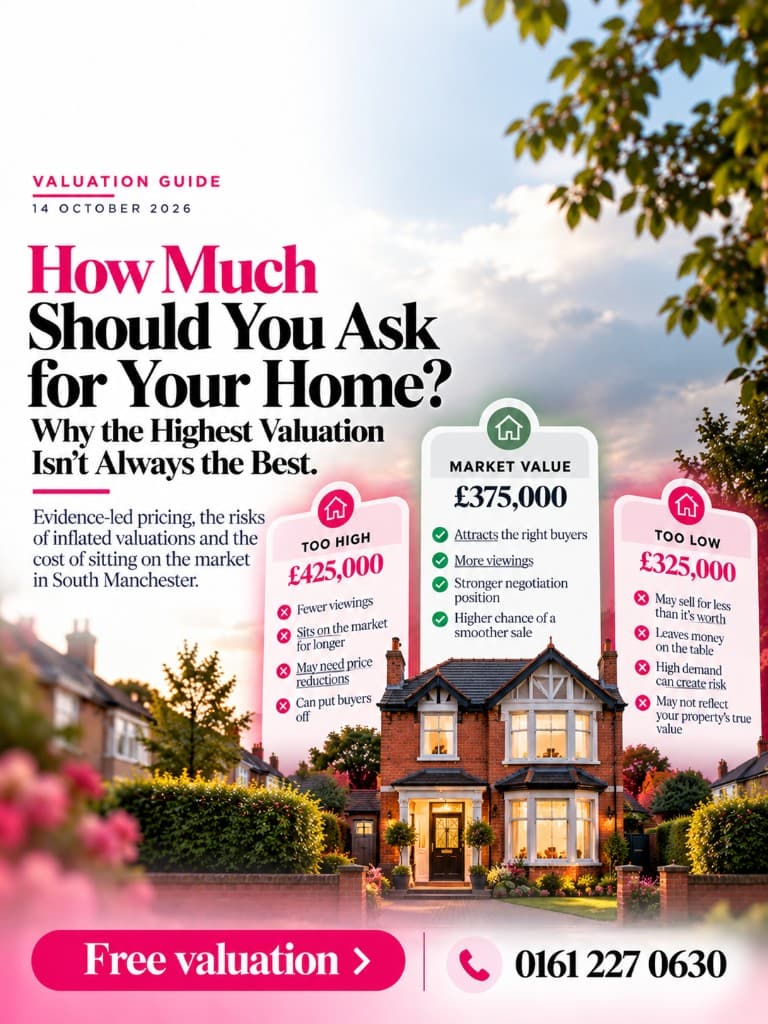
If you are thinking about selling your home in South Manchester, one of the first questions you will probably ask is: how much is my house worth?
Your property may be your largest financial asset, so naturally, you want to achieve the best possible selling price.
But when you invite several estate agents to value your property, you might receive very different figures.
One agent suggests £325,000. Another recommends £375,000. A third believes you should advertise at £425,000.
These figures are illustrative examples, not actual valuations.
Which valuation should you trust?
The highest figure may initially seem the most attractive. However, an ambitious valuation is not necessarily the most accurate, and an inflated asking price can sometimes make selling more difficult.
In this guide, Delisa Miller (NW) Ltd explains how property valuations work, why asking prices matter and how homeowners across South Manchester can make more informed selling decisions.
1. What is a property valuation?
An estate agent's property valuation is an assessment of what a home may reasonably achieve in the current market.
It is not a guarantee of the eventual selling price.
A valuation normally considers several factors, including:
- Recently sold comparable properties
- Property size and accommodation
- Condition and presentation
- Location and nearby amenities
- Garden and parking arrangements
- Extensions and improvements
- Current buyer demand
- Competing properties available for sale
For example, two three-bedroom houses in Didsbury might appear similar online but have different market values because one has been substantially renovated while the other requires modernisation.
An accurate valuation should account for these differences.
2. Why do estate agents sometimes give different valuations?
Different agents may interpret market evidence differently.
One might place greater emphasis on recent completed sales, while another may focus on competing properties currently advertised.
Agents may also have different opinions about buyer demand or the potential impact of a property's individual features.
However, sellers should also be aware of the possibility of an inflated valuation being used to win their instruction.
What is an inflated valuation?
An inflated valuation occurs when an agent recommends an asking price that is not adequately supported by the available market evidence.
This may happen because of genuine overoptimism or because a high figure is more likely to persuade a homeowner to choose that agent.
The important distinction is between an ambitious but defensible pricing strategy and a figure that lacks credible supporting evidence.
A higher valuation is only useful if the market is prepared to support it.
3. The risks of pricing your home too high
Many sellers assume they can start high and reduce the price later if necessary.
While this approach can sometimes work, it carries risks.
Fewer enquiries and viewings
Buyers frequently search property portals using price filters.
If your asking price places the property above the budget range of suitable buyers, they may never see the listing.
Buyers who do find it may compare the property with larger or better-presented homes available at similar prices.
Longer time on the market
An overpriced property may remain advertised for longer than expected.
A lengthy marketing period does not automatically mean something is wrong with a home, but it can cause prospective buyers to question why it has not sold.
Price reductions
If the initial asking price fails to generate sufficient interest, a reduction may become necessary.
A price reduction can help reposition the property, but it also means the original marketing period may not have reached the most appropriate audience.
Potentially weaker negotiating position
Some buyers may interpret a lengthy marketing period or repeated price reductions as an opportunity to negotiate.
This does not mean every price reduction leads to a lower eventual selling price, but it is a factor worth considering.
4. What happens when your home is priced at market value?
Market value is not always one exact number.
Properties can reasonably fall within a valuation range depending on their features, condition and buyer demand.
An evidence-led asking price aims to position the property competitively while reflecting what comparable homes have achieved.
Attracting relevant buyers
A realistic asking price can help ensure your property appears in searches conducted by buyers with suitable budgets.
Encouraging viewing enquiries
When a property compares favourably with alternatives, prospective buyers may be more willing to arrange a viewing.
Supporting negotiations
An asking price supported by comparable sales provides a clearer foundation for discussing offers.
However, accurate pricing does not guarantee a quick sale, multiple offers or a particular final price.
Mortgage availability, market conditions and individual buyer circumstances can all influence the outcome.
5. Could pricing your property too low also be a mistake?
Yes.
An unnecessarily low asking price could mean that a seller accepts less than the property might otherwise achieve.
However, some agents may recommend a deliberately competitive asking price as part of a considered marketing strategy.
The effectiveness of this approach depends on buyer demand, the property and the seller's circumstances.
A lower asking price does not automatically create a bidding war.
Before agreeing to this strategy, ask your estate agent to explain the supporting evidence, potential benefits and risks.
6. How comparable property sales influence your valuation
Recent comparable sales are among the most useful sources of information when estimating property value.
However, comparing properties requires more than matching bedroom numbers.
Location
A three-bedroom house in Chorlton may not be directly comparable with one in Fallowfield or Hulme.
Even within the same neighbourhood, different streets can attract different levels of buyer interest.
Condition
A newly renovated property may command a different price from a similar home requiring substantial repairs.
Size and layout
Floor area, room proportions and the practicality of the layout can influence value.
Gardens and parking
Private gardens, driveways and garages can be attractive features, although their financial contribution varies by location and property type.
Extensions and improvements
An extension may add useful living space, but the cost of completing it does not necessarily translate into an equivalent increase in market value.
A professional valuation should consider these factors alongside completed sales and current competition.
7. Asking price versus sold price: Understanding the difference
One of the most common mistakes homeowners make is assuming that advertised asking prices represent actual market values.
A property advertised for £400,000 has not necessarily sold for £400,000.
It may sell for more, less or not sell at all.
For this reason, completed sales can provide stronger evidence than asking prices alone.
Current listings are still useful because they show the competition your home may face.
A balanced valuation considers both.
8. Does the time of year affect your asking price?
Property activity can vary throughout the year.
Some periods may attract more enquiries, while holidays and seasonal changes can affect viewing arrangements.
However, there is no universal rule that guarantees a higher sale price in a particular month.
Interest rates, mortgage affordability, housing supply and wider economic conditions may be more influential.
For South Manchester homeowners, the best time to sell often depends on personal circumstances and the readiness of the property.
9. How to choose the right estate agent valuation
If you receive several valuations, avoid choosing an agent based solely on the highest figure.
Instead, ask the following questions.
What comparable properties support this valuation?
The agent should be able to explain which recent sales they consider relevant and why.
What makes my property different?
A good valuation should account for your home's individual characteristics.
Who is the likely buyer?
Understanding whether the property is most likely to attract first-time buyers, families, investors or downsizers can influence the marketing strategy.
What happens if we don't receive enough enquiries?
Ask how the agent intends to monitor interest and when the asking price or marketing strategy might be reviewed.
How will the property be marketed?
Professional photography, accurate floor plans, well-written descriptions and appropriate exposure can help buyers understand the property.
An asking price is only one part of the selling strategy.
10. How to prepare your South Manchester home for valuation
You do not need to undertake a complete renovation before requesting a valuation.
However, providing accurate information can help the agent understand the property.
Before your appointment, consider gathering:
- Details of extensions and improvements
- Relevant planning and building control documents
- Energy Performance Certificate information
- Leasehold or freehold details
- Information about parking and boundaries
- Details of any known property issues
You may also want to make a list of improvements completed during your ownership.
An estate agent can then assess the property's condition and features in context.
11. Why local knowledge matters in South Manchester
South Manchester contains a wide range of property markets.
Buyers looking in Didsbury may have different requirements from those considering Withington, Whalley Range, Chorlton, Fallowfield or Hulme.
Property styles, transport connections, local amenities and buyer preferences vary.
This is why broad Manchester averages should not be treated as a substitute for an individual valuation.
The most useful assessment combines local knowledge with recent comparable sales and an understanding of current competition.
12. The best asking price is one supported by evidence
When selling your home, it is natural to want the highest possible price.
But the figure an estate agent suggests and the amount a buyer ultimately pays are not the same thing.
An inflated valuation can create unrealistic expectations, while an unnecessarily low asking price may not reflect the property's potential.
The aim should be to establish an asking price that supports your selling objectives and is backed by credible market evidence.
The highest valuation is not always the best valuation. The most useful valuation is one you can understand, question and support with evidence.
Thinking of selling your home in South Manchester?
Whether you own a Victorian terrace in Whalley Range, a family home in Didsbury, an apartment in Hulme or a property in Chorlton, understanding its current market value is an important first step.
At Delisa Miller (NW) Ltd, we help Manchester homeowners explore their selling options and develop an appropriate property marketing strategy.
If you are considering selling, contact our team to arrange a free, no-obligation property valuation.
Book your valuation at delisamiller.co.uk/selling/valuation or call 0161 227 0630.
Delisa Miller (NW) Ltd — 44 Hulme High Street, Manchester, M15 5JP.
This article provides general property information. Property valuations are estimates, not guarantees of an eventual selling price. Individual outcomes depend on property characteristics and market conditions.
Related reading
Got a Property Question?
Our team is here to help. Whether you're buying, selling or letting — get in touch today.